
Are You Feeding the Right Guests?
Forget the £40 probiotic. The most powerful gut health tool you own is a shopping trolley and the science on what to put in it is clearer than the wellness industry wants you to think.
There are roughly 38 trillion bacteria living in your body and the overwhelming majority of them are in your large intestine, sitting quietly at the end of your digestive tract, waiting to see what you send down.
They are not passengers. They are chemists. Feed them well and they manufacture compounds- short-chain fatty acids like butyrate — that fuel the cells lining your colon, tighten your gut barrier and calm inflammation throughout your body. Feed them badly and the useful species starve while the less helpful ones take the run of the place.
Your gut is home to bacteria, fungi and other microorganisms. Together, they form a complex ecosystem known as the gut microbiome
Here’s the good news: this is one of the few areas of health where the intervention is genuinely delicious.
The problem is not what you’re eating. It’s what you’re not.
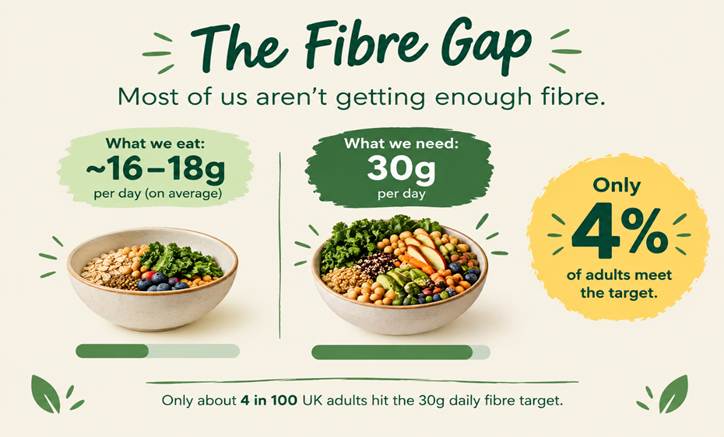
Most gut health advice is a list of things to cut out. Gluten. Dairy. Nightshades. Anything beige. The evidence points almost entirely in the opposite direction. The single biggest gut-related gap in the modern diet is a deficit, not an excess — and it’s fibre. UK adults are advised to eat 30g of fibre a day. National Diet and Nutrition Survey data suggest average intake sits somewhere around 16–18g and that only about 4 in 100 adults actually hit the target. That is not a rounding error. That’s a nation running its gut microbiome on half rations.
And the payoff for closing that gap is not trivial. A landmark series of systematic reviews and meta-analyses in The Lancet, pooling almost 135 million person-years of data from 185 prospective studies and 58 clinical trials, found that the highest fibre consumers had a 15–30% lower rate of all-cause and cardiovascular mortality, and lower incidence of coronary heart disease, stroke, type 2 diabetes and colorectal cancer, compared with the lowest consumers. The greatest risk reduction clustered at intakes of 25–29g per day, with dose-response curves suggesting further benefit above that.
Twenty-five grams of fibre. That’s it. That’s the “biohack.“
Thirty plants a week: the number worth remembering
If counting grams makes you want to lie down, there’s a friendlier target — and it comes from one of the largest microbiome studies ever run.
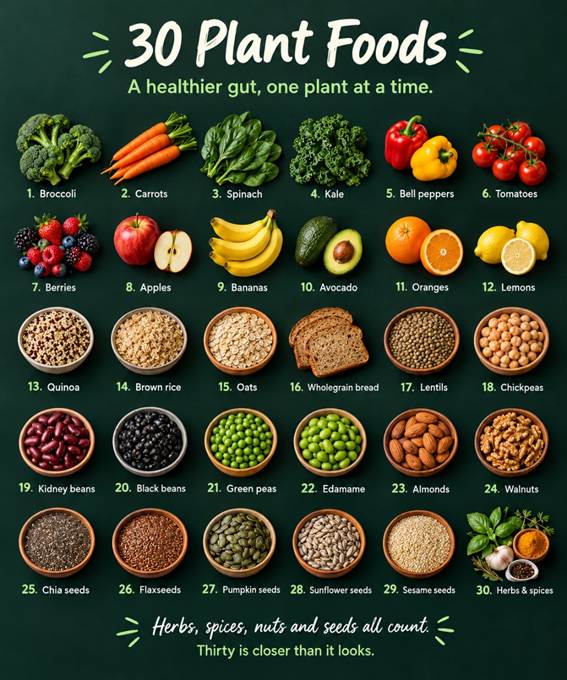
The American Gut Project analyzed thousands of stool samples alongside detailed dietary data. The finding that escaped the lab and went global: participants who ate more than 30 different plant types per week had more diverse gut microbiomes than those eating 10 or fewer types — regardless of whether they identified as vegetarian, vegan or omnivore.
Two things make this the most useful number in gut health.
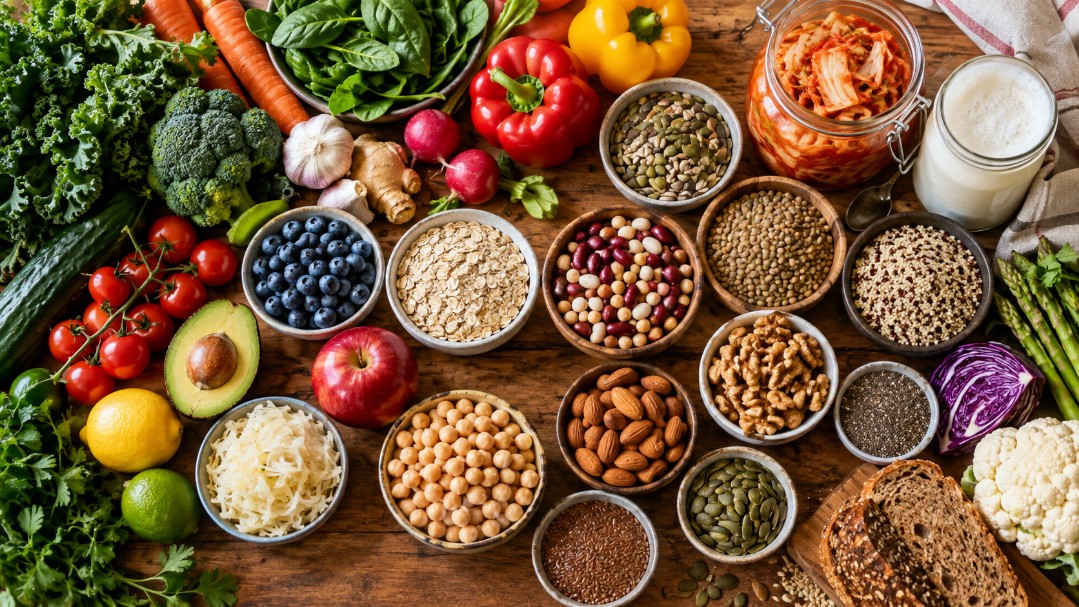
First, “plants” is a generous category. Vegetables, fruit, wholegrains, nuts, seeds, beans, lentils, herbs and spices all count. A tablespoon of mixed seeds on your porridge is three points. A jar of mixed bean salad is four. Chilli flakes, thyme, cinnamon, black pepper — all plants.
Second, it rewards variety instead of restriction. Different fibres feed different microbial species. Broccoli does not do the job of oats, and oats do not do the job of chickpeas. Diversity on the plate builds diversity in the gut.
A week of plant points, without trying
| Meal | Plants |
| Overnight oats: oats, chia, blueberries, walnuts, cinnamon | 5 |
| Lentil soup: red lentils, carrot, onion, garlic, celery, cumin | 6 |
| Big lunch salad: rocket, tomato, cucumber, chickpeas, red onion, olives, pumpkin seeds | 7 |
| Stir-fry: brown rice, broccoli, pepper, spring onion, ginger, sesame seeds, cashews | 7 |
| Snacks across the week: apple, pear, almonds, dark chocolate, popcorn | 5 |
| TOTAL | 30 |
No supplements, no specialist shop, no restriction.
The fermented food surprise
Now for the study that genuinely upset expectations.
Stanford researchers ran a 17-week randomized trial putting healthy adults on either a high-fibre diet or a high-fermented-food diet, with deep immune profiling throughout. The team expected fibre to be the star.

Instead: the high-fibre arm increased microbiome-encoded carbohydrate-active enzymes while overall community diversity stayed stable, whereas the high-fermented-food diet steadily increased microbiota diversity and decreased inflammatory markers. Nineteen inflammatory proteins fell in the fermented food group, including IL-6; a cytokine implicated in chronic disease risk across the board.
The Fiber Connection
Certain gut bacteria ferment dietary fiber, producing short-chain fatty acids that help maintain the gut environment. Learn more in our guide to dietary fiber and its benefits for digestion and overall health
The foods involved were unglamorous and cheap: yogurt, kefir, fermented cottage cheese, kimchi and other fermented vegetables, vegetable brine drinks and kombucha. Participants went from almost none to around six servings a day.
This does not mean fibre lost. The researchers themselves noted that a short-term fibre increase may not be enough on its own to shift diversity — some people’s microbiomes simply lack the machinery to break down the extra load at first. The practical reading is that fibre and fermented foods are teammates, not rivals. Fibre supplies the raw material; fermented foods deliver live microbes and their by-products.
Start small: a spoonful of live yogurt or kefir at breakfast, a forkful of kimchi or sauerkraut alongside dinner. Look for “live cultures” on the label and buy from the chilled section — pasteurized sauerkraut on a warm shelf is just sour cabbage.
The Gut–Brain Thing: Real, but keep your Head
You’ve read that your gut is your “second brain.” It’s an overstatement wrapped around something real.
A four-week randomized trial in Molecular Psychiatry tested a “psychobiotic diet” — heavy on prebiotic and fermented foods — against a control diet in healthy adults. Perceived stress fell by 32% in the diet group, compared with 17% in controls.
Here is the part most headlines skipped: the improvement was significant within the intervention group, but the difference between groups did not reach statistical significance, and the researchers themselves called for more work on mechanisms, Encouraging signal. Not a prescription. Diet is not a treatment for anxiety or depression, and anyone struggling should speak to a GP.
Remember : a healthy gut microbiome is not about eliminating all bacteria. It is about supporting a balanced microbial community through a varied diet and healthy lifestyle
Four things that will not fix your gut
- Juice cleanses. Juicing strips out the fibre. You are removing the one component your microbes actually want.
- Expensive multi-strain probiotic capsules, for most people. Probiotics have genuine, strain-specific clinical uses — antibiotic-associated diarrhoea, some IBS presentations. As a daily insurance policy for a healthy adult eating 16g of fibre, they’re an expensive distraction from the obvious fix.
- Cutting out entire food groups without a reason. Every unnecessary exclusion narrows your plant diversity, which is precisely the wrong direction.
- Going from 15g to 40g of fibre on a Monday. You will be miserable and you will blame fibre. Increase by about 5g a week, drink more water as you do, and give your microbes time to adapt. Bloating during a sensible ramp-up is usually fermentation, not failure — but persistent pain, blood, or unexplained weight loss is never a gut health project. That’s a GP appointment.
Summary
- Aim for 30g of fibre a day. Most people are at half that.
- Count 30 different plants a week. Herbs, spices, nuts and seeds all count.
- Add one fermented food daily. Live yogurt, kefir, kimchi, sauerkraut.
- Increase gradually. Roughly 5g of extra fibre a week, with more fluid.
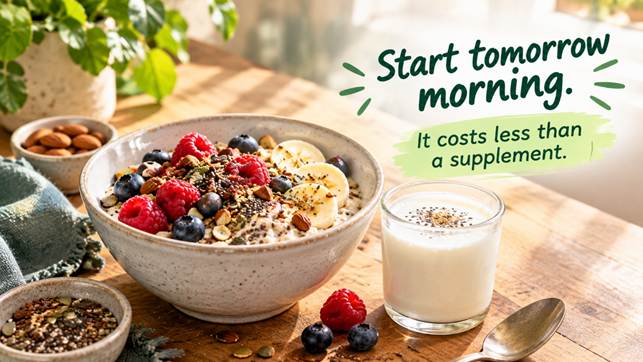
- Spend your money on food, not capsules. A £3 bag of lentils outperforms a £40 supplement.
Your gut microbes have been waiting all day for dinner. Give them something interesting.
References
- Berding, K., Bastiaanssen, T.F.S., Moloney, G.M., Boscaini, S., Strain, C.R., Anesi, A., Long-Smith, C., Mattivi, F., Stanton, C., Clarke, G., Dinan, T.G. and Cryan, J.F. (2023) ‘Feed your microbes to deal with stress: a psychobiotic diet impacts microbial stability and perceived stress in a healthy adult population’, Molecular Psychiatry, 28(2), pp. 601–610. doi: 10.1038/s41380-022-01817-y
- British Nutrition Foundation (no date) Fibre. Available at: https://www.nutrition.org.uk/nutritional-information/fibre/
- Food Foundation (2025) UK still failing to meet basic dietary guidelines. Available at: https://foodfoundation.org.uk/news/uk-still-failing-meet-basic-dietary-guidelines
- McDonald, D., Hyde, E., Debelius, J.W., Morton, J.T., Gonzalez, A., Ackermann, G., et al. (2018) ‘American Gut: an open platform for citizen science microbiome research’, mSystems, 3(3), e00031-18. doi: 10.1128/mSystems.00031-18
- Mullie, P., Vankrunkelsven, P. and Autier, P. (2023) ‘Re: Berding et al., Feed your microbes to deal with stress’, Molecular Psychiatry, 28(9), pp. 3566–3567. doi: 10.1038/s41380-023-02270-1
- Reynolds, A., Mann, J., Cummings, J., Winter, N., Mete, E. and Te Morenga, L. (2019) ‘Carbohydrate quality and human health: a series of systematic reviews and meta-analyses’, The Lancet, 393(10170), pp. 434–445. doi: 10.1016/S0140-6736(18)31809-9
- Sender, R., Fuchs, S. and Milo, R. (2016) ‘Revised estimates for the number of human and bacteria cells in the body’, PLoS Biology, 14(8), e1002533. doi: 10.1371/journal.pbio.1002533
- Stanford Medicine (2021) Fermented-food diet increases microbiome diversity, decreases inflammatory proteins, study finds. Available at: https://med.stanford.edu/news/all-news/2021/07/fermented-food-diet-increases-microbiome-diversity-lowers-inflammation.html
- Wastyk, H.C., Fragiadakis, G.K., Perelman, D., Dahan, D., Merrill, B.D., Yu, F.B., et al. (2021) ‘Gut-microbiota-targeted diets modulate human immune status’, Cell, 184(16), pp. 4137–4153.e14. doi: 10.1016/j.cell.2021.06.019
